Waterloo Epoxy Flooring has spent more than 20 years on epoxy flooring in Oelwein and across northeast Iowa, and the floors that teach us the most are the ones that get splashed with something worse than water. A coating that looks fine in a showroom can fail in weeks when it meets a chemical it was never chosen to resist. Our work starts by asking what will actually land on the slab.
That question shapes every proposal we write. We name the product line, the number of coats and the finished thickness on paper, so an owner or a plant manager can hold the installed floor up against the quote. We also map cracks, spalls and old coatings before we price anything, and we say plainly when a slab needs repair or replacement first.
The same discipline applies whether the floor sits under a forklift charger or a family pickup. A garage, a basement and a production aisle each have their own failure mode, and the right system for one is often wrong for the next. The sections below walk through the conditions that make this town different.
From Railroad Shops to a Battery Plant
Chicago Great Western roots
Oelwein grew up as a railroad town. The Chicago Great Western made it the site of its locomotive and car repair shop, where four lines converge, and those shops were completed and put into operation in May 1899. The Hub City Heritage Museum on 2nd Avenue SW still tells that story for anyone who wants the long version.
The shop ground did not go quiet when the passenger era ended. Transco acquired surplus facilities, including the roundhouse, on August 1, 1969, and Transco Railway Products now repairs about 150 rail cars a month. We have not seen a floor specification for that work, so we mention it as part of the town’s identity rather than as a coating example.
East Penn and the fill, form and finish line
The newer industrial story is batteries. East Penn opened a $70 million facility on 40 acres in Oelwein on February 7, 2018, built to fill, form, finish and distribute lead-acid batteries. By 2024 KCRG reported more than 350 employees there and more than seven million batteries shipped a year.
Filling a lead-acid battery means handling sulfuric acid electrolyte, which follows from what the word means in the battery trade. We have no relationship with East Penn, we have never coated its floors, and we have not read any detail of its flooring. What the plant does tell us is that acid handling is a normal part of working life in this town, and that shapes how we think about floors in smaller shops, distributors and fleet garages nearby.
Why that changes the conversation
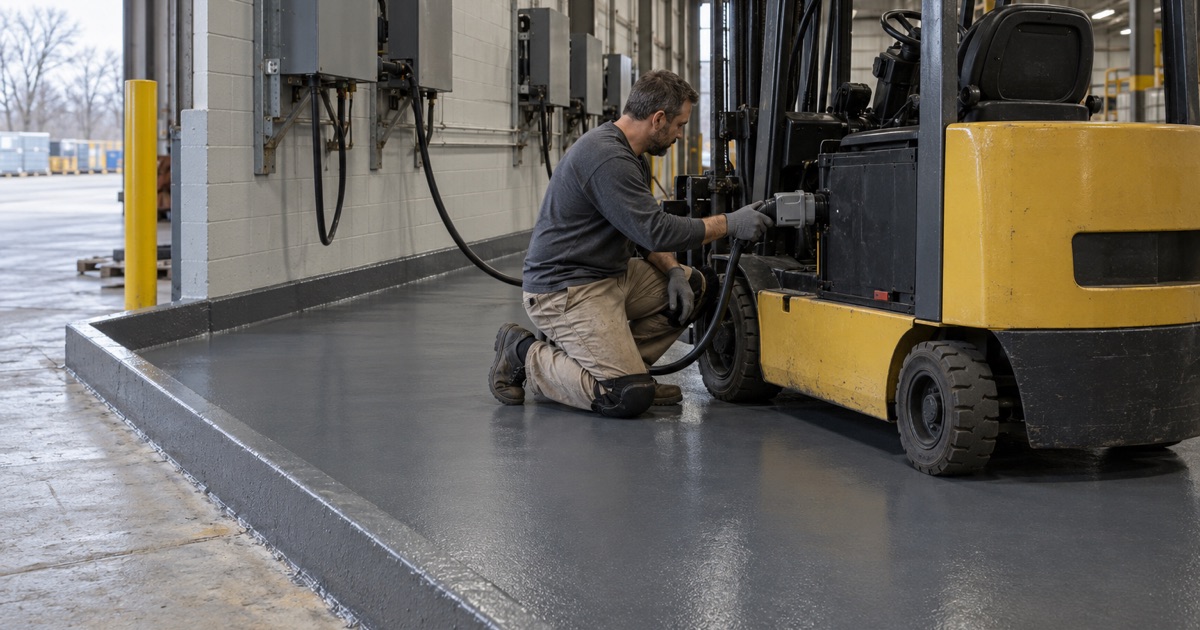
When a customer here says a floor sees chemicals, we take it literally. A maintenance bay that charges forklift batteries, a shop that services equipment batteries, or a warehouse with a charging row all put acid within reach of the concrete. Those floors deserve a different system than a residential garage, and a different conversation before anyone talks price.
Looking for epoxy-flooring closer to Vinton? See Vinton Epoxy-Flooring.
What Sulfuric Acid Does to Bare Concrete
The cement paste goes first
Concrete is aggregate held together by hardened cement paste, and that paste is alkaline. Sulfuric acid attacks it directly, dissolving the binder at the surface and leaving the sand and stone exposed. Repeated drips etch the slab, loosen aggregate and open pores that soak up the next spill even faster.
The damage rarely shows up as one dramatic hole. More often it is a rough, sandy patch under a charger or along a fill station, with loose grit that tracks across the building. By the time the patch is obvious, the concrete beneath it has usually lost enough soundness that it has to be cut back and rebuilt before any coating can go down.
Why a garage-grade epoxy is the wrong answer
A thin, general-purpose epoxy sold for garages is built to resist hot tire pickup and the occasional oil drip. It is not chosen for acid exposure, and when electrolyte finds a pinhole or a worn spot, it can travel under the film and attack the concrete from beneath. The coating then lifts in sheets, and the owner is left paying to grind off a failed floor.
No coating is immune to every chemical in every concentration and at every temperature. Resistance depends on the exact chemical, how strong it is, how long it sits and how hot the room runs. That is why we ask for the chemicals by name rather than accepting a general description like harsh stuff.
Surface preparation comes before chemistry
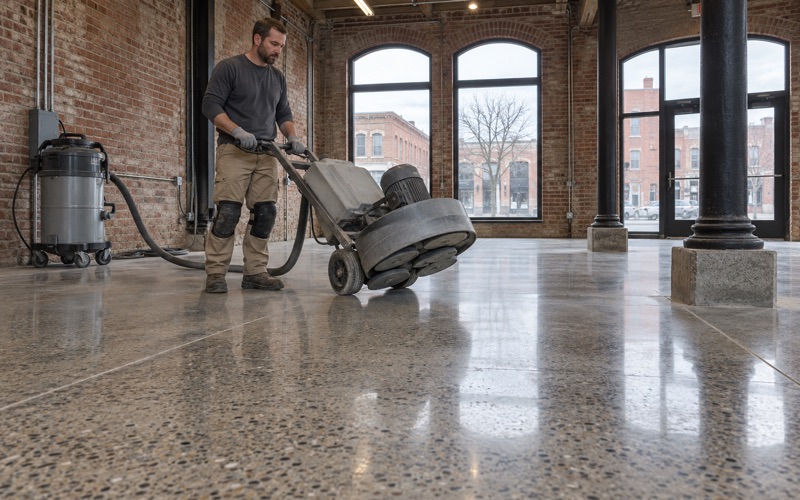
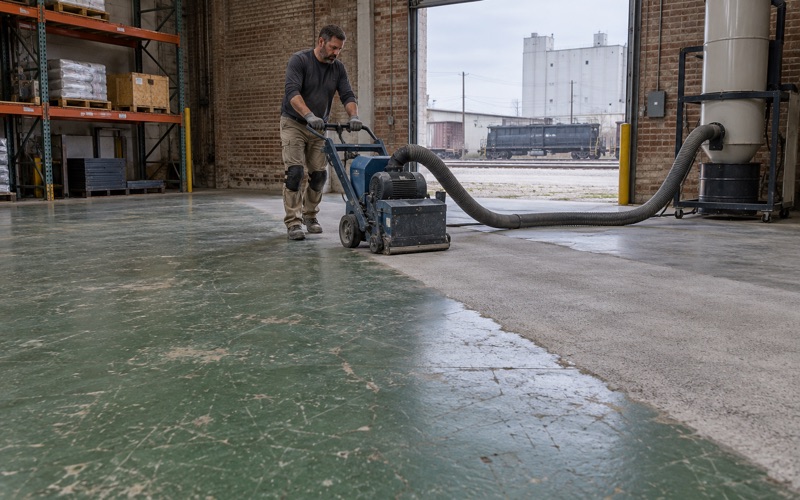
Even the right resin fails on a weak surface. We open every slab with a diamond grinder or a shot blaster to reach an ICRI concrete surface profile suited to the system, and we never use an acid etch to do it. Pouring acid on a floor to prepare it for an acid-resistant coating makes no sense, and it leaves residue that fights adhesion.
Grinding dust is captured at the machine with a vacuum, not rinsed toward a floor drain or a storm inlet. On an acid-damaged slab, that also keeps contaminated fines out of the drain system. Soft concrete is removed until we reach sound material, and patching is done with a repair product compatible with the coating that follows.
Flushing, Neutralizing and Choosing the System
What the OSHA charging-area rule says
Federal rules for powered industrial trucks address where batteries are charged. Under 29 CFR 1910.178(g)(1), battery charging installations shall be located in areas designated for that purpose. Paragraph (g)(2) requires facilities for flushing and neutralizing spilled electrolyte, along with fire protection, protection of charging equipment from trucks, and ventilation for gassing batteries.
The rule does not name a floor coating, and we never present one as satisfying it. Iowa also runs its own state OSHA plan, and we leave compliance questions to the facility’s safety staff. What the rule does make clear is that a charging floor will be flushed and neutralized, so the floor has to survive that routine as well as the spill itself.
Washdown is part of the floor’s life
A charging area gets wet on purpose. Water, neutralizing solution and the acid they are cleaning up all sit on the surface, sometimes for hours, and then get squeegeed toward a drain. Every seam, crack and cove joint in that path becomes a place for the mix to collect.
We plan these floors with slope to drain, coved edges where the wall meets the slab, and a texture chosen by the broadcast and topcoat rather than promised as a slogan. A smooth floor is easier to clean but slick when wet, and a heavy aggregate grips well but traps residue. The right answer depends on who walks the room and how it is cleaned.
Matching the system to the chemical you actually have
The choice of resin follows the exposure list. For many acid environments that means a novolac-type epoxy or a urethane cement system rather than standard 100% solids epoxy, and the topcoat is selected for the same chemical. We compare the owner’s actual chemicals, concentrations and cleaning products against the manufacturer’s published resistance data before we commit to a product line.
Plant and shop floors are phased around shifts, with overnight and weekend windows when a line cannot stop. Cure schedules follow slab temperature and dew point at the surface, not the calendar, so a charging row comes back into service when the coating is ready rather than when the schedule says so.
Oelwein’s Older Homes and Garages
Slabs from before 1940
Most of our residential calls here involve houses with a long history. Census estimates show 39.3 percent of Oelwein’s homes were built in 1939 or earlier, and the town is overwhelmingly detached, owner-occupied houses. Many of those properties carry basement floors and detached garages that have been patched, painted and repaired several times.
Old paint and sealers have to come off before a new system goes on, and we map them along with cracks and spalls during the first visit. Some of those slabs were poured without a vapor retarder underneath, which matters for the next step. We would rather tell an owner a slab needs work than coat over a problem and watch it peel.
Moisture, water and winter salt
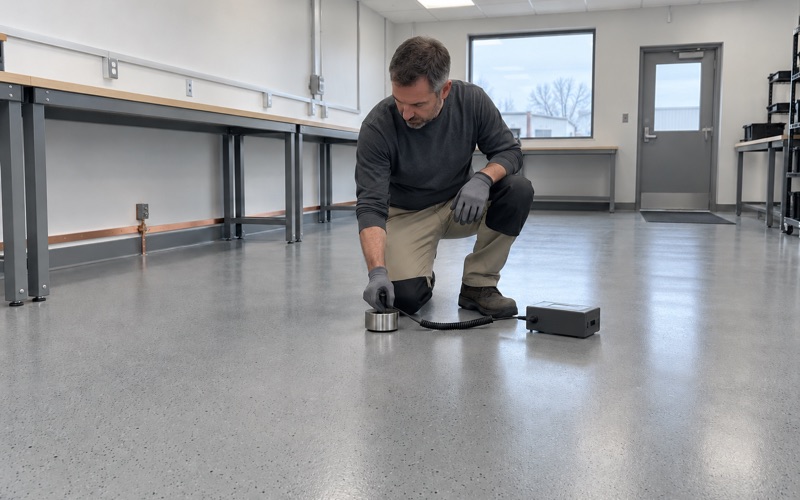
A moisture test is part of the written scope before the price is final. Depending on the slab, that may be an ASTM F2170 in-situ relative humidity probe, an ASTM F1869 calcium chloride test or a simple ASTM D4263 plastic sheet check. We test regardless of the year a house was built, because a newer garage is not automatically a drier one.
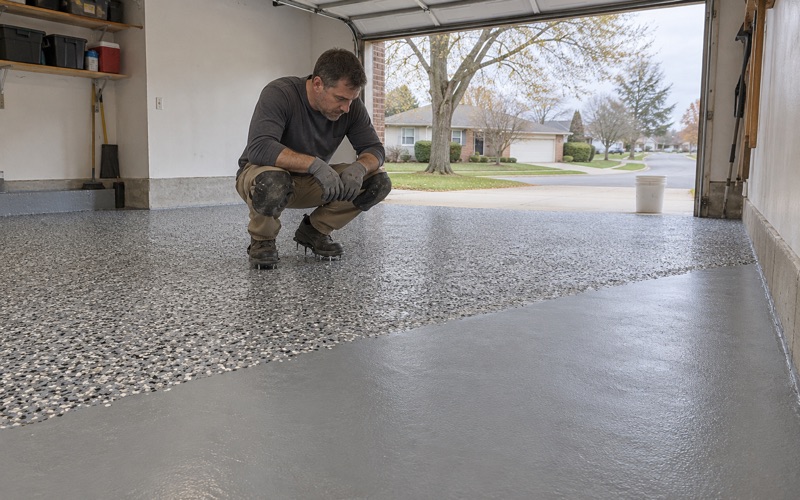
Basement floors are read for past water first, with the sump pit and floor drain checked, because a coating does not stop seepage or hydrostatic pressure. In garages, the system is chosen to stand up to the brine and rock salt that ride in on tires from November through March. We also explain warranty exclusions before the job is sold, and moisture vapor transmission is the first one we name.
Permits, inspections and timing
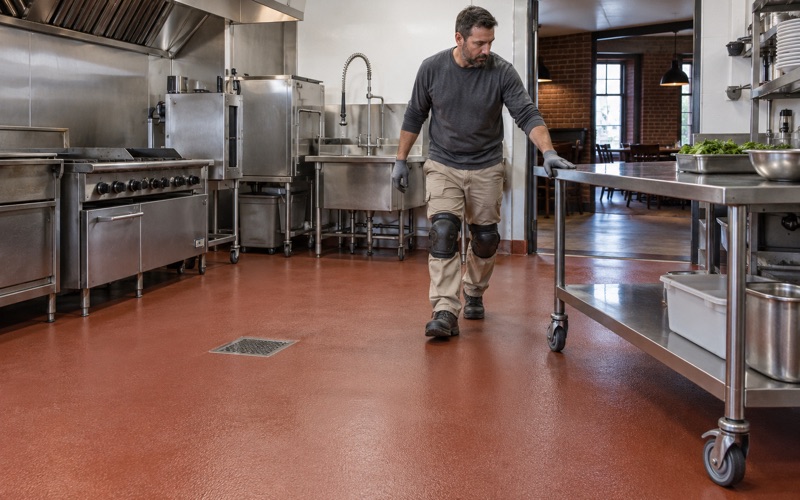
The City of Oelwein Community Development Department at 20 2nd Ave SW handles building permits and posts both a Permits Required List and a Permits Not Required List. A floor coating on its own is often minor work, but slab replacement or drainage changes can fall under the inspector’s review, so we check the lists before we schedule. Restaurant and food-service kitchens in Fayette County answer to the Black Hawk County Health Department, which serves Fayette under contract with the state.
Winter timing deserves honesty. An unheated garage in a northeast Iowa January will not let a coating cure properly, and we tell owners to wait for warmer slab conditions instead of forcing the job. For attached garages and basements we offer low-odor products as a comfort and re-entry choice, never as a legal requirement, and we never sell a coating as radon work, since radon mitigation in Iowa requires a separate state credential.
- 20+ Years Coating Concrete
- Moisture Test in Every Scope
- Free Written Estimates