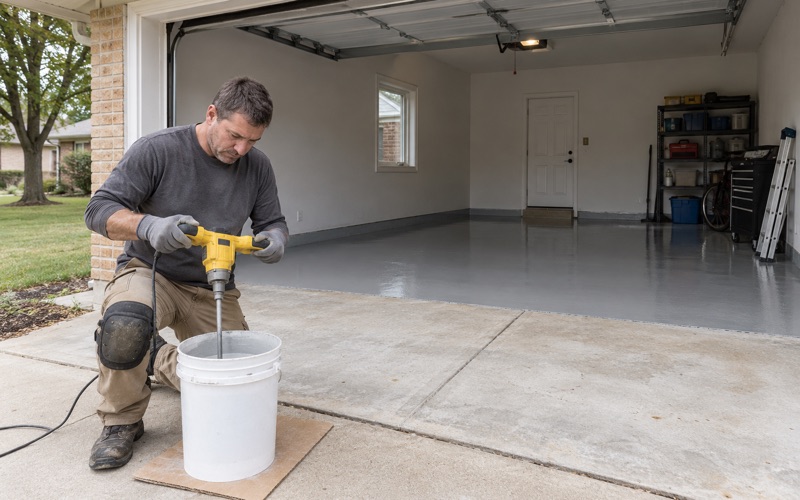
Waterloo Epoxy Flooring has spent more than 20 years on epoxy-flooring in Vinton and the surrounding stretch of northeast Iowa, coating garages, basements, shops and commercial rooms. Most of what decides whether a floor lasts happens before any resin is opened: what is already on the slab, how it comes off, and how much moisture the concrete is carrying. That order of work is what this page is about.
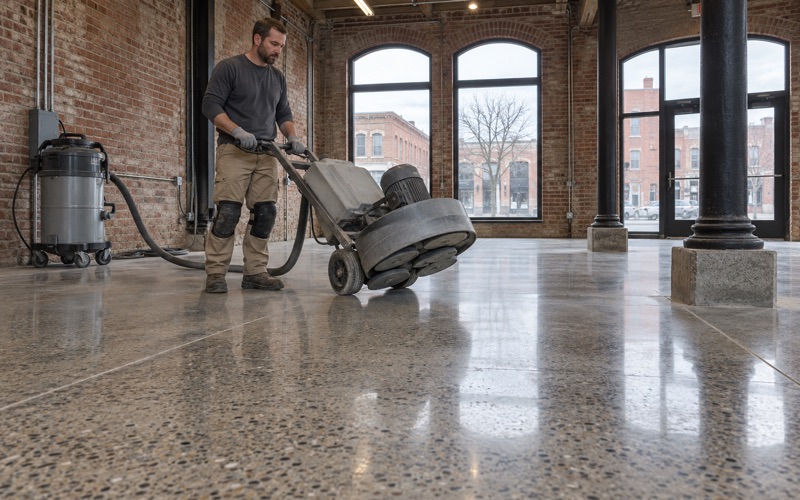
We open every slab mechanically, with a diamond grinder or a shot blaster, because an acid etch leaves too little profile for a coating to grip. That makes the question of what sits on top of the concrete a practical one. A painted garage floor is one thing; an old institutional room with layers of tile and adhesive is another, and federal rules treat the two differently.
Our proposals put the product line, the coat count and the finished thickness in writing, so the floor can be checked against the quote when the job is done. Moisture testing is part of that written scope before the price is final, and so is any repair the slab needs first. Below we walk through how that plays out in Vinton, from a state campus changing hands to the older houses around downtown.
A State School Campus Looking for New Tenants
From state institution to city property
Vinton is the Benton County seat, and for most of its history it has also been home to the Iowa Braille and Sight Saving School, a state institution dating from 1852. In November 2019 the Board of Regents took up a proposal to sell the property to the City of Vinton for one dollar: 11 buildings on 48 acres, with more than half the site leased to the federal government as a regional AmeriCorps site. The city bought the campus in 2020.
The school had already stopped housing students; as of fall 2011 it no longer had a residential component. AmeriCorps NCCC has kept its North Central Region headquarters on the grounds since 2008. What changes now is the rest of the campus, which is being readied for uses it was never built for.
Emptying nine buildings for new tenants
By July 2026, KCRG reported, the campus was owned by the Hobarts, of Hobart Historical Restoration, and a four-day auction was under way across nine buildings. Lockers, seating and even an auditorium organ were on the block. In BJ Hobart’s words, the sale was about trying to get the buildings empty to prepare for new tenants.
The third floor of the main building, which holds the school’s history museum, was left out of the sale. Everywhere else, the rooms being cleared out are classrooms, corridors and service spaces built for a state school. Each one that becomes an office, a studio or a workshop will need a floor that suits its new job.
What a new tenant inherits underfoot
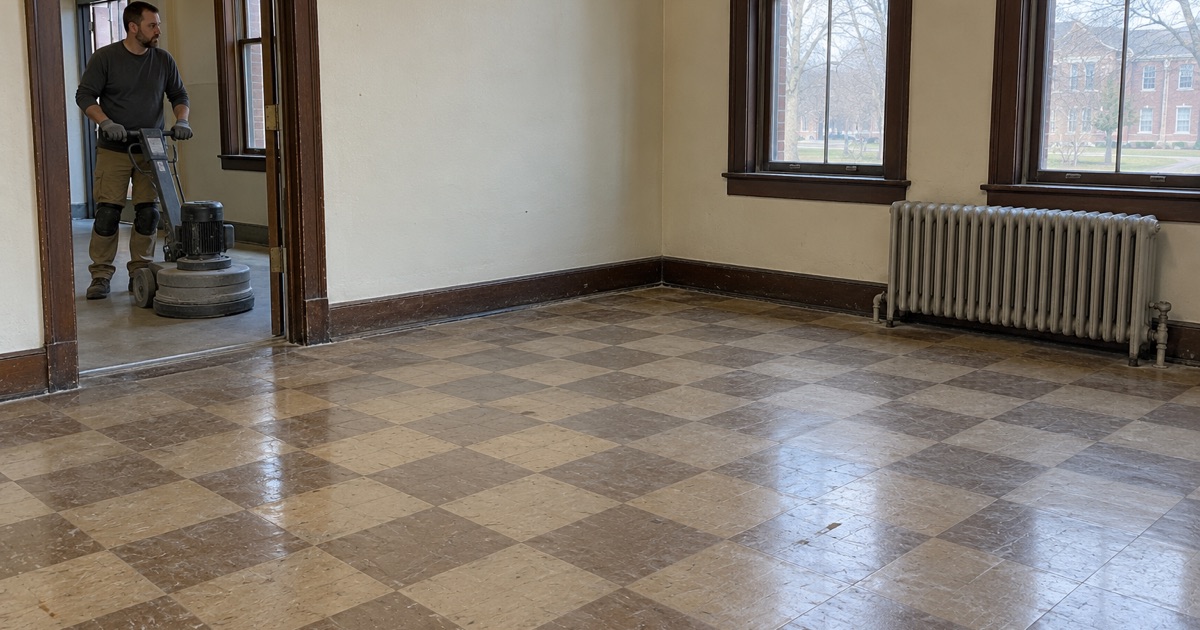
An empty institutional room rarely comes with bare concrete. More often there is resilient flooring of some age, glued to the slab, sometimes with another layer under it and a black or yellowed adhesive under that. A tenant who wants a durable coated floor is looking at taking all of that up before anything else happens.
That is normal adaptive reuse work, and it is exactly where the sequence matters. Removal and grinding are the first steps of a coating job, yet in an older institutional building they are also the steps federal asbestos rules care about most. We plan the job so that question is answered before our equipment arrives.
Looking for epoxy-flooring closer to Evansdale? See Epoxy-Flooring in Evansdale.
Why Old Institutional Floors Are Surveyed Before They Are Ground
What federal asbestos rules call renovation
The federal asbestos standard, 40 CFR Part 61 Subpart M, defines a facility as any institutional, commercial, public, industrial or residential structure, excluding residential buildings of four or fewer dwelling units. Renovation means altering a facility or any of its components in any way. Pulling up an old floor in a former school building and grinding the slab beneath it fits that definition plainly.
Under 61.145(a), before a renovation the owner or operator must thoroughly inspect the part of the facility where the work will occur for asbestos. Fuller requirements apply once a renovation disturbs at least 160 square feet on facility components other than pipes, a threshold a single classroom floor can pass easily. So the asbestos inspection before renovation is the first scheduled step, not an afterthought.
Resilient floor covering meets the grinder
The rule names resilient floor covering containing more than 1 percent asbestos as Category I nonfriable material. Left in place, it is treated one way. Once it will be sanded, ground, cut or abraded, it becomes regulated asbestos-containing material, which brings a different set of handling obligations.
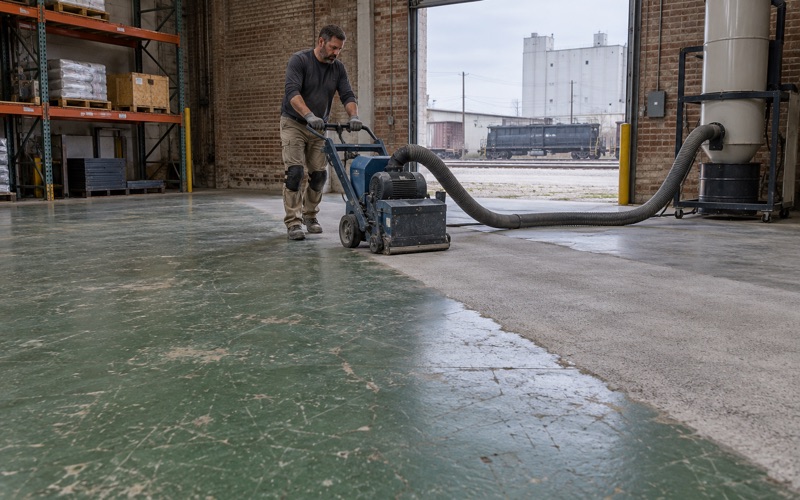
Grinding is how we prepare almost every slab for epoxy, and it is precisely the kind of abrasion the rule describes. That is why, on a room with older resilient flooring or mastic, we ask for the survey results before we schedule the grinder. Our crew does no asbestos abatement; if a survey calls for it, that work is done by others before we start.
An inspection is not a finding
Nothing we have read reports an asbestos survey or result for the former campus. The federal rule triggers an inspection; it does not presume what the inspection will find. Plenty of old flooring turns out to be clear, and some does not, and only sampling tells the two apart.
We say this to owners and tenants plainly because it shapes the calendar and the budget without assuming a bad outcome. A survey that comes back clear lets us move straight to prep. One that does not changes who touches the floor first, and the coating schedule simply follows it.
From Survey to Grinder to Coating
Mapping the slab once the floor is clear
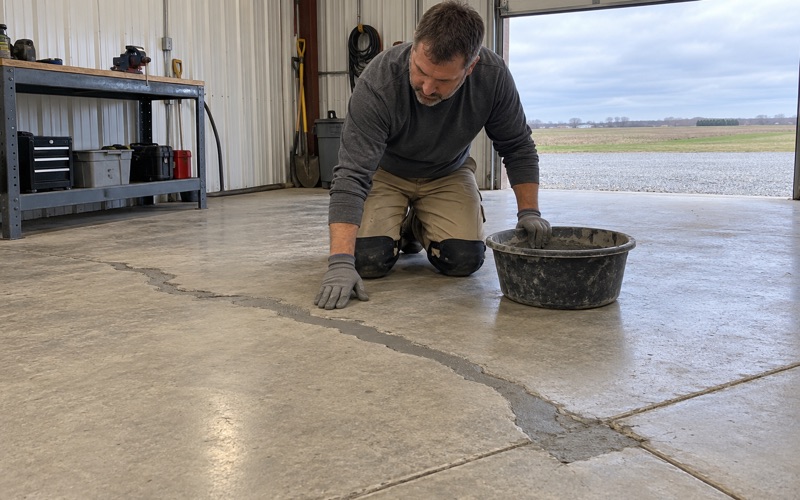
With the old covering gone, we walk the bare concrete and map cracks, spalls, patches and leftover coatings before writing a final scope. Institutional slabs often carry decades of changes: filled trenches, old fixture anchors and patches that do not match the original pour. Some of that can be repaired and coated over.
Some of it cannot, and when a section needs repair or replacement before coating, we say so in writing rather than burying it under resin. A coating copies whatever it is laid on. Taking the time to read the slab first is cheaper than chasing a crack line through a finished floor a year later.
Grinding with the dust captured at the machine
Diamond grinding and shot blasting cut a surface profile the coating can lock into, and we match the profile to the system going down. Thin sealers need a lighter profile, while thicker 100% solids epoxy or a urethane cement system wants a coarser one. The profile is checked against ICRI concrete surface profile references rather than judged by eye.
Grinding dust is pulled into a vacuum at the machine instead of being washed toward a floor drain or out to a storm inlet. In an occupied building that matters for the tenants next door. It also keeps the slab clean enough for primer to bond the same day.
Moisture testing before the price is final
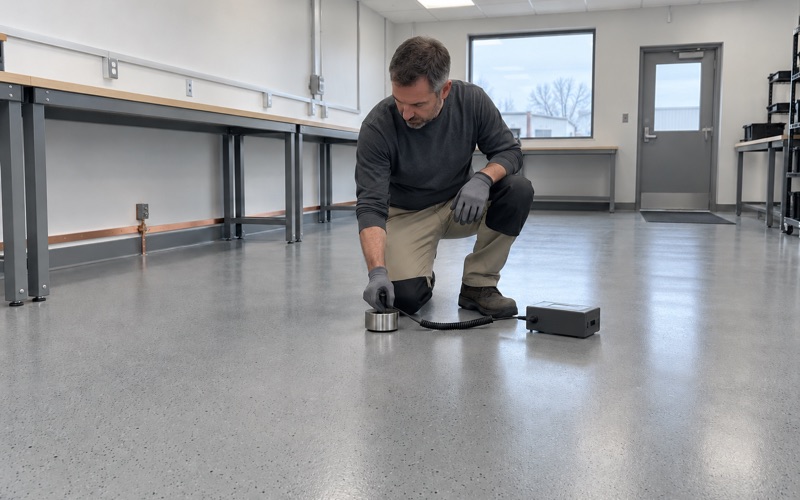
Every slab gets a moisture test before we commit to a price, whether it sits in a former classroom or under a house. We use ASTM F2170 in-situ relative humidity probes or ASTM F1869 calcium chloride testing, sometimes with an ASTM D4263 plastic sheet test as a first read. Old slabs laid without a vapor retarder can carry more moisture than they look.
When the numbers call for it, the scope includes a moisture-mitigation primer, and we explain before the job is sold that moisture vapor transmission is the first exclusion on any coating warranty. Cure timing follows slab temperature and the dew point spread at the surface, which keeps amine blush off a fresh coat.
Choosing the system for the room
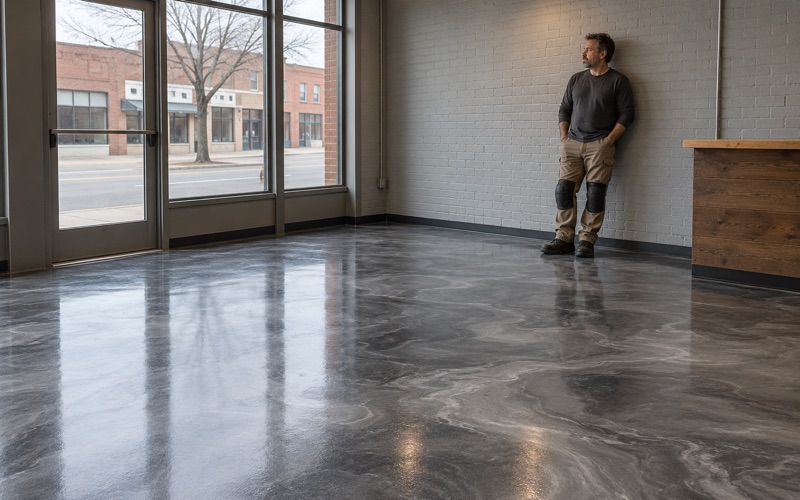
A former classroom turned into a studio or office usually suits a 100% solids epoxy with a vinyl flake or quartz aggregate broadcast and a polyaspartic topcoat. A workshop with rolling loads or heavy wear may justify more build. Where electronics are involved, static-dissipative flooring with a stated resistance range is an option we specify by product.
Slip resistance comes from the broadcast and topcoat we choose, written into the proposal rather than promised as a slogan. Where tenants share a building, low-odor products can make re-entry more comfortable. We offer them as a comfort choice, not as anything Iowa law requires.
Vinton’s Older Homes and the Four-Unit Line
Houses below the federal line
Most of our Vinton work is residential, and the town’s housing is mostly owner-occupied detached houses. The federal facility definition excludes residential buildings of four or fewer dwelling units, so a single-family garage or basement sits outside the inspection requirement that governs the campus.
That does not make every old floor in a house simple. Around 43.9 percent of Vinton’s homes were built in 1939 or earlier, and many of their basements and garages carry decades of patches, paint and old tile. We map what is there and talk through it before grinding, even where the federal rule does not reach.
Basements and garages in older houses
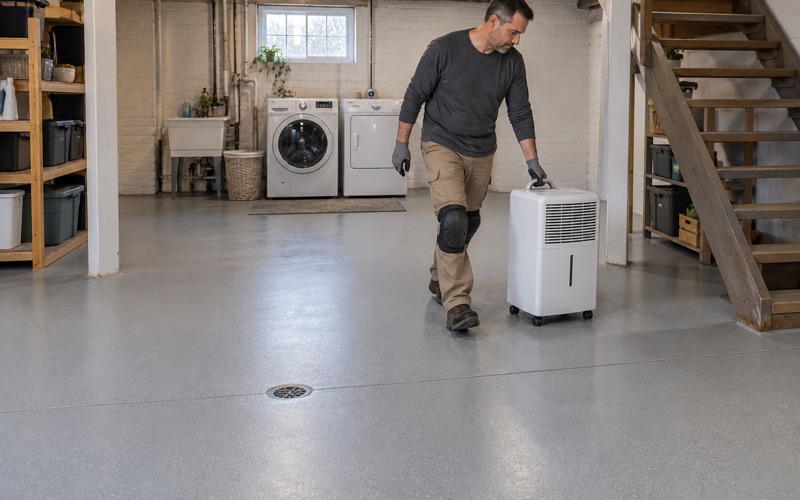
In an older basement we look for past water first, checking the sump pit and floor drain, because a coating does not stop seepage or hydrostatic pressure under the slab. Efflorescence and old water lines on the walls tell us a lot before a probe goes in. We test newer houses too, because a recent build is not automatically a drier slab.
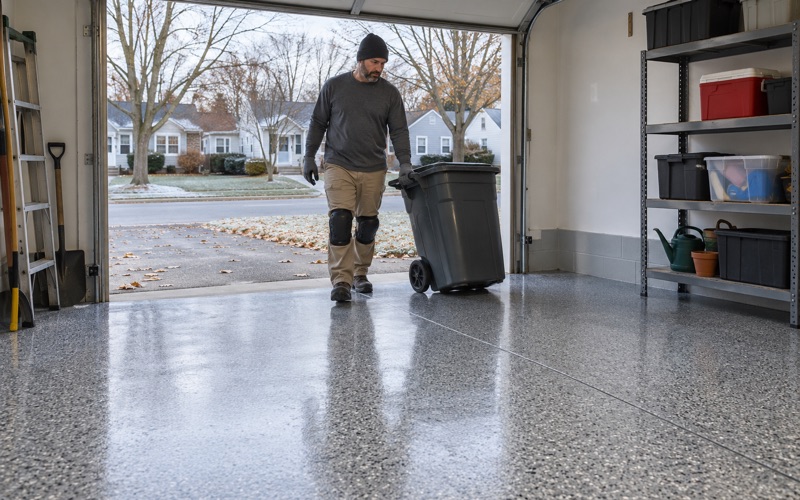
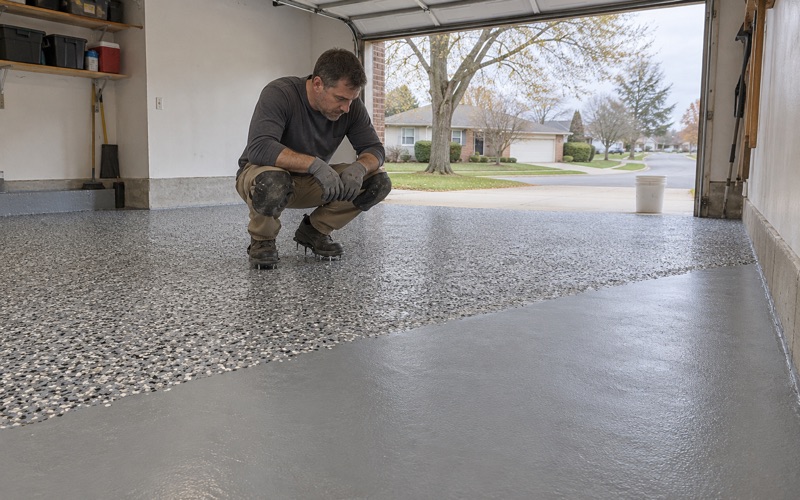
Garages in Vinton take the same brine and rock salt from November through March as any in northeast Iowa, so we choose systems that resist salt and hot tire pickup. An unheated garage in midwinter is told to wait for warmer slab temperatures. A floor coating is never sold as radon work, since radon testing and mitigation in Iowa take a state credential.
Kitchens and food-service floors in Benton County
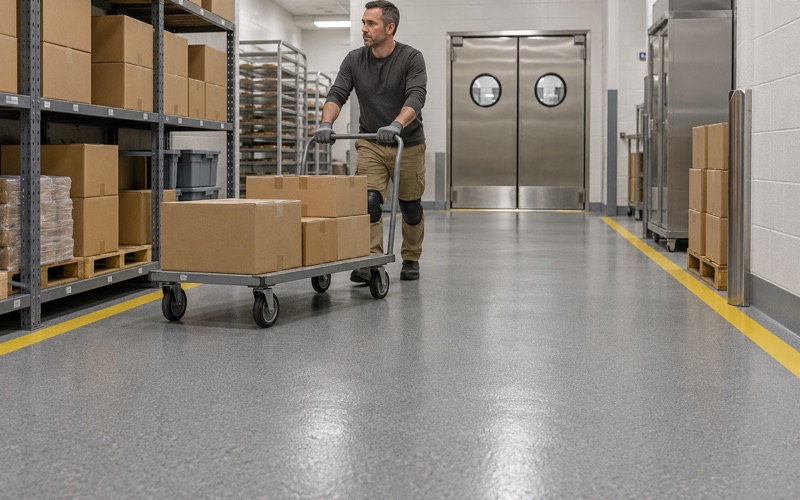
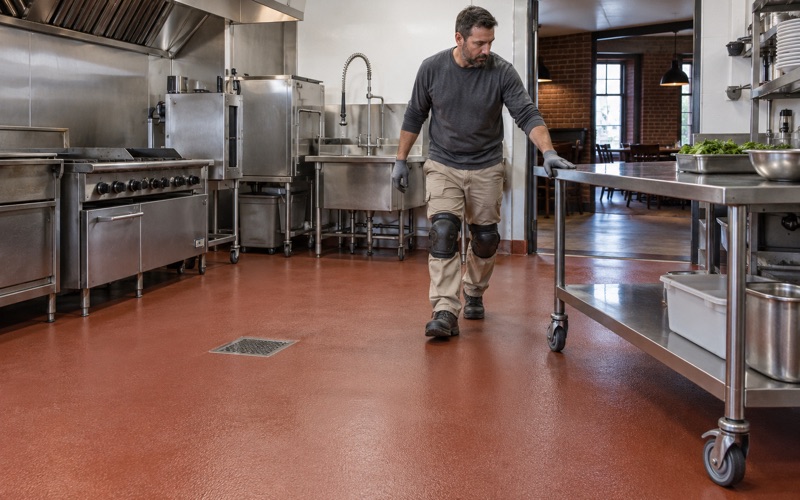
Any new tenant on the old campus or downtown who plans to serve food will answer to the Black Hawk County Health Department, which serves Benton County under contract with the state. We plan those floors around the FDA Food Code as Iowa adopts it, with coved bases at the wall and a texture specified for the wet areas.
That planning starts at the same place as everything else on this page: what is already on the floor, whether it needs a survey before it is ground, and how much moisture the slab is carrying. Get those three right, and the coating is the easy part.
- 20+ Years Coating Concrete
- Moisture Test in Every Scope
- Free Written Estimates